Friday, February 8, 2019

Are Businesses Worldwide Suffering From a Trust Crisis?


Are Businesses Worldwide Suffering From a Trust Crisis?

Are Businesses Worldwide Suffering From a Trust Crisis?

STORY HIGHLIGHTS

  • Worldwide, two-thirds of adults say corruption is widespread in business
  • There are three essential elements of a high-trust culture
  • Many U.S. employees don't benefit from ethical compliance programs

This article is from The Real Future of Work: The Trust Issue.Download the full digital publication today.

"Trust is like the air we breathe -- when it's present, nobody really notices. When it's absent, everyone notices." -- Warren Buffett
The legendary American investor spoke the above quote following the 1991 Salomon Brothers bond-trading scandal, in which traders submitted false bids in an attempt to corner the U.S. Treasury bond market.
The scandal forced Buffett, a Salomon investor, to take over as interim chairman and root out unethical practices to help the firm avoid criminal prosecution. But Salomon Brothers was never the same; it eventually became part of Citigroup and most of its trading business was disbanded.
In the early 21st century, Buffett's observation about trust in business has only become more apropos.
The accounting scandals of 2001 to 2003 devastated corporate giants Enron and WorldCom among others, wiping out billions in shareholder value. And in 2008, widespread unethical lending practices triggered a global financial crisis from which it has taken a decade for many economies around the world to recover.
The widening impact of corporate misconduct in these cases highlights an irrefutable truth: In a globalized, highly interconnected world, trust is more important than ever to business success and sustainability over the long term. More than ever, integrity is the ultimate brand attribute.
Companies build trust on a daily basis in routine interactions with customers, consistently delivering on their promises or going to great lengths to rectify the situation when they cannot. They behave as if their customers' satisfaction and wellbeing are their most important considerations, leaving customers with a feeling of partnership rather than adversity.
That means establishing a culture in which all employees understand that their own self-interest and the interests of the organization are aligned with -- rather than unrelated to -- the interests of their customers.
That may sound self-evident, but many organizational cultures -- whether purposely or inadvertently -- encourage opportunistic behavior.
Poor moral leadership, performance incentives that lead employees to be single-mindedly hypercompetitive, lack of open and frequent discussion of ethical implications -- such attributes make it more likely that employees will view relationships with customers and even fellow employees with a zero-sum mentality.
In other words, they have a sense that their own success will come at the expense of others, which promotes ethical "blindness" and makes trusting relationships harder to sustain.

Worldwide, two-thirds of adults say corruption is widespread in business
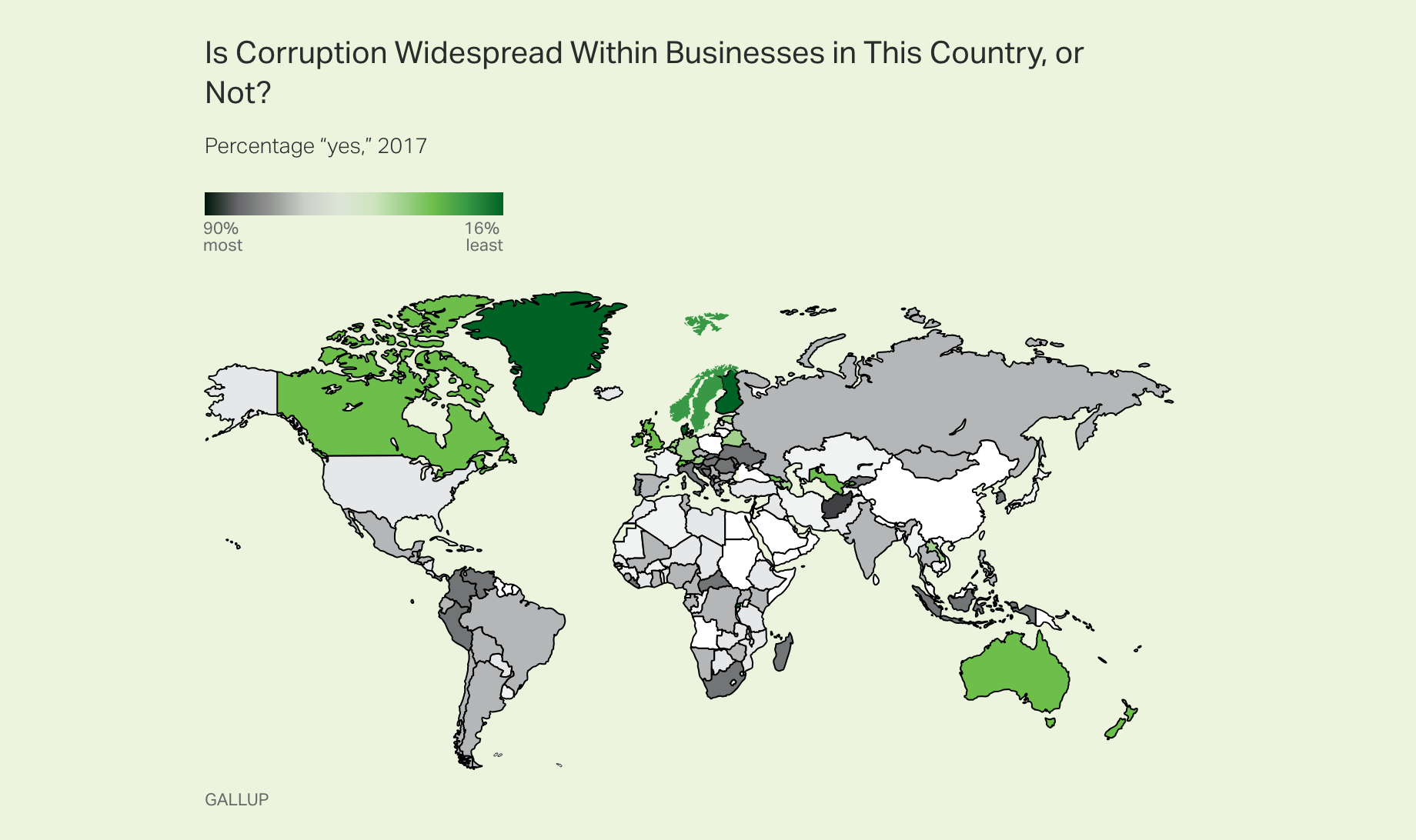
World map: Is corruption widespread within businesses in this country or not?
Even for well-managed companies, establishing a reputation for integrity can be a challenge in the modern era, as employees, customers and investors in most countries start from a point of skepticism.
Residents of more economically developed regions are generally less likely to say corruption is widespread in business; nonetheless, 60% of adults in the U.S. responded this way in 2017, as did 52% in Western Europe overall.
Gallup's global research found that in 2017, 68% of adults worldwide believed corruption was widespread among businesses in their country. Worldwide, that figure has changed little over the past decade, though there has been significant movement in some individual countries, such as Germany.
Residents of more economically developed regions are generally less likely to say corruption is widespread in business; nonetheless, 60% of adults in the U.S. responded this way in 2017, as did 52% in Western Europe overall.
Within Western Europe, however, there is a strong north/south gradient; the vast majority of residents in several southern nations -- including Portugal, Spain and Italy -- say corruption is widespread in their country's businesses, versus less than one-third in the Nordic states.

Germans have seen a clear decline in business corruption since 2006.

Germany offers a striking exception to the lack of change in perceived business corruption among G20 countries.
In 2006, 83% of Germans said corruption was widespread in the country's businesses; however, that figure dropped steadily over the ensuing decade to 43% in 2017.
Since the late 2000s, when high-profile corruption scandals rocked several large German companies, including the multinational conglomerate Siemens and the Volkswagen subsidiary MAN, German policymakers have increasingly targeted bribery and other forms of corporate corruption.
Among the most recent reforms is a 2015 measure that dramatically expanded anti-corruption legislation, including making it a criminal offense to offer, pay or take bribes in commercial practice.
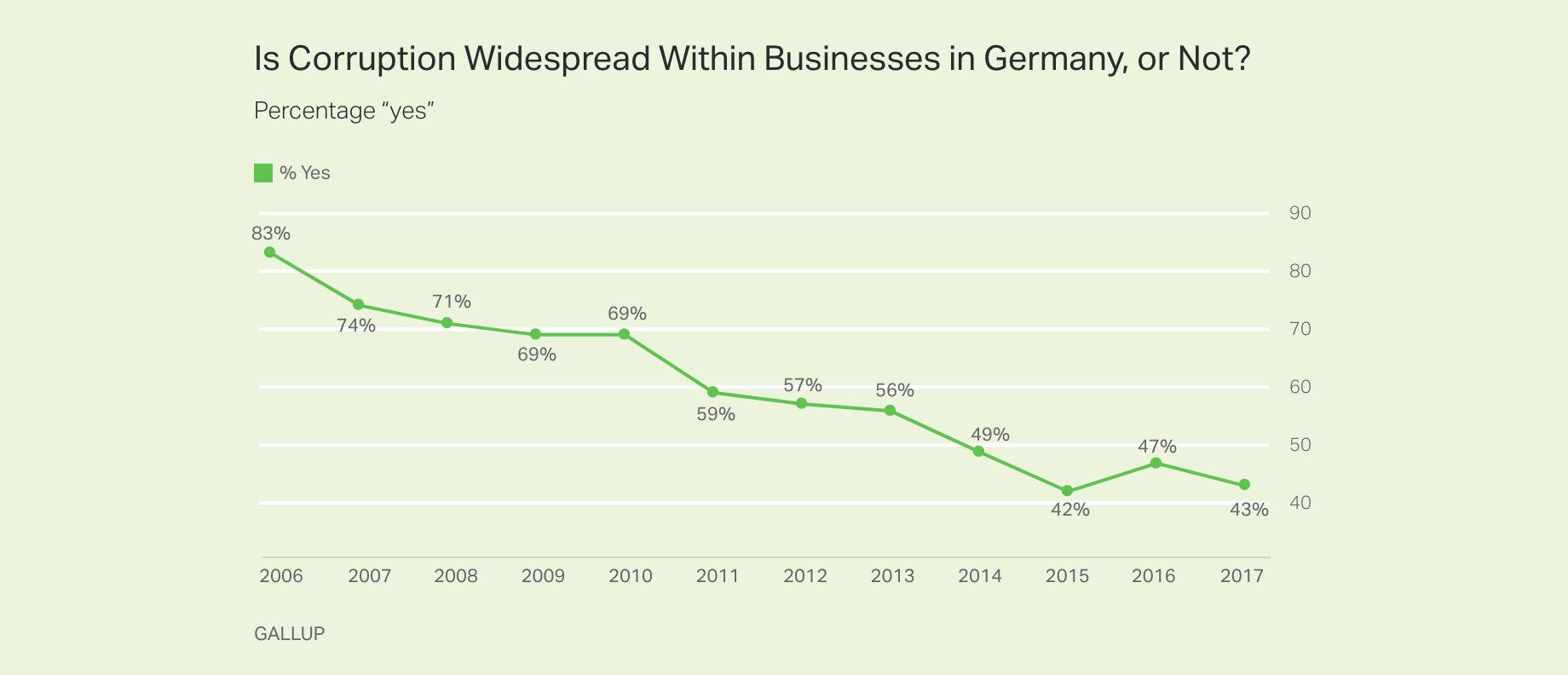
Line graph. Is corruption widespread in Germany? 2006-2017 trend.

Most employees are unsure their organizations will always treat customers ethically.

In four European countries -- France, Germany, Spain and the U.K. -- Gallup asked employed adults how committed their employers are to doing the "right thing," especially with regard to customers.
In each case, no more than one-third agree unreservedly -- i.e., by selecting "5" on a 5-point agreement scale.
Most notably with regard to trust, just one-third of employees (33%) strongly agree that their company would never lie to its customers or conceal relevant information from them.
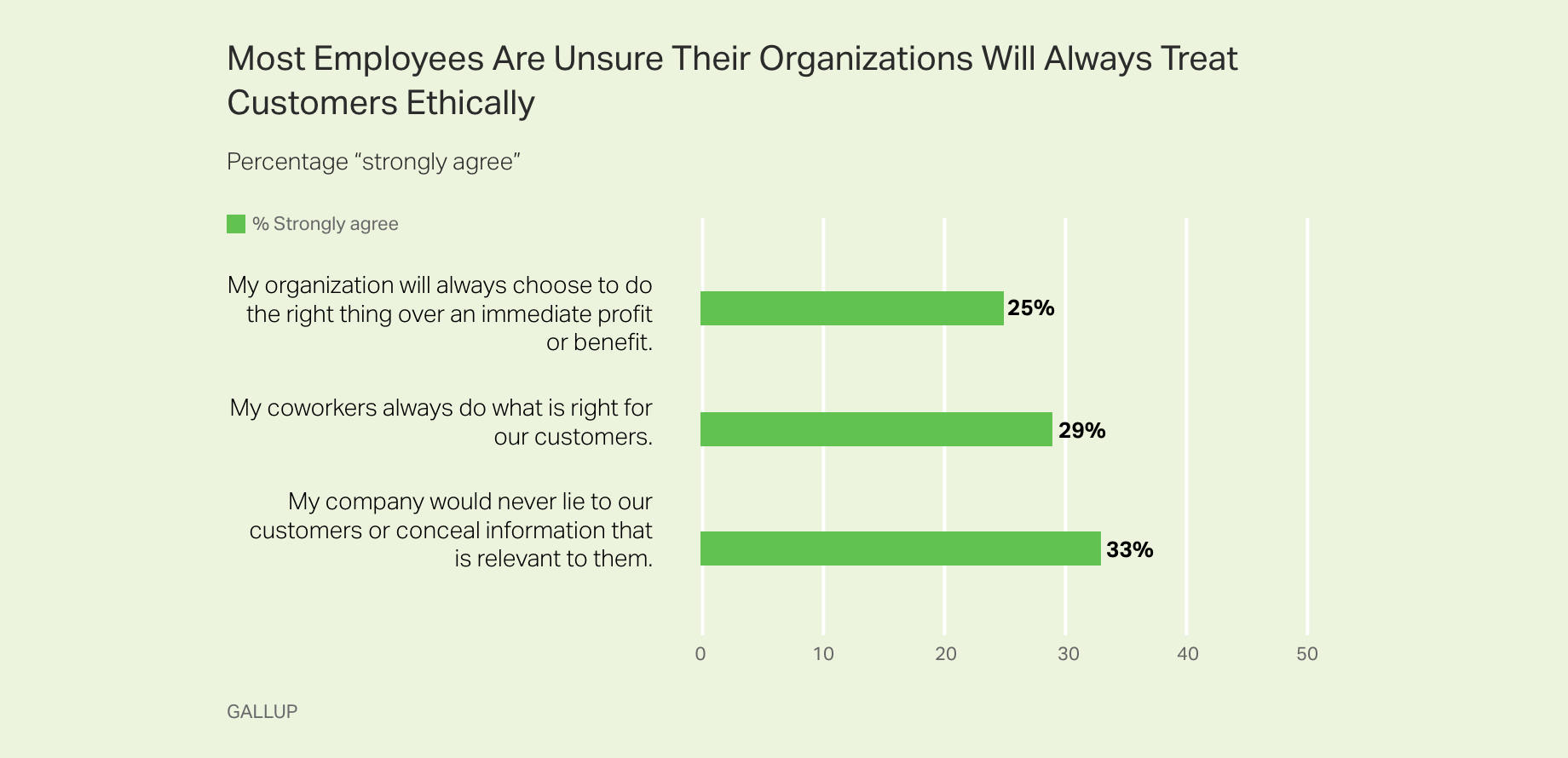
​Bar graph. Most employers are unsure their organizations will always treat customers ethically.​

Ethical and business concerns have aligned in the global economy

In previous eras, trust was more often a product of ongoing relationships between individuals who did business together. People knew their bankers, merchants and employers personally and could assess the content of their character.
These days, business transactions tend to be less personal and more far-reaching than they were even a few decades ago.
Trust remains a vital form of business currency, but customers rely on different signals to convey a company's trustworthiness -- including, in many cases, a wealth of information about its ethical track record and the experiences of its customers and employees.
In fact, globalization is making adherence to commonly accepted ethical standards necessary not just for building trust with employees and customers, but for full-fledged participation in the worldwide economy.
Just as common technological protocols have made the rapid spread of mobile phones and internet around the world possible, common ethical standards provide a consistent set of rules that allow parties from different cultures and institutional environments to have confidence that they can do business together without being taken advantage of.
The success of global "sharing economy" platforms like Uber and Airbnb has been possible, in large part, because those businesses have developed transparent rating systems that help customers feel they can trust millions of new drivers and hospitality providers.
However, trust has also become a more important consideration within organizations.
Given the rapid pace of change in many industries, driven by digitization, globalization and emerging technologies such as artificial intelligence, many employees wonder if their jobs are secure and need to feel that their managers are always open and honest with them.
The success of global "sharing economy" platforms like Uber and Airbnb has been possible, in large part, because those businesses have developed transparent rating systems that develop trust with customers.
Perceived trustworthiness has also become an important recruiting consideration.
Expectations for corporate responsibility have changed since the "greed is good" ethos of the 1980s.
Employees want to know their organizations operate in a socially responsible manner. Those who believe their company will always choose to do the right thing over making an immediate profit are more likely to say they would recommend it as a place to work and that they will stay there for another three years.
Gallup research has shown that millennial-age employees in particular want their careers to coincide with their personal values; they view their jobs as sources of meaning and purpose, rather than just a way to make a living.

Three essential elements of a high-trust culture

Businesses that sustain trusting relationships with employees and customers are distinguished by three central priorities, around which leaders build high-integrity organizational cultures.
  1. Make strong customer value the ultimate business goal.

Organizations need an authentic, customer-centric purpose to guide their strategic focus and daily activities. Such a purpose, clearly and commonly articulated by leaders and managers, encodes ethical standards into the DNA of an organization.
If a company exists to improve the life of its customers, violating their trust or harming their communities through unethical behavior becomes not just a moral issue, but a strategic concern.
As an example, in restructuring their operations after suffering massive losses in the global financial crisis, many retail banks made restoring customer relationships their paramount leadership concern, with many articulating a renewed focus on customer-centricity supported by a set of clearly stated ethical standards and responsibilities.
By contrast, widespread concerns about Facebook's data-sharing policies and possible privacy violations have led to slower user and revenue growth and prompted a major ad campaign intended to regain users' trust.
  1. Establish integrity as a primary organizational value.

Buffett once said he considers integrity a more essential hiring consideration than intelligence or energy:
"We look for three things when we hire people. We look for intelligence, we look for initiative or energy, and we look for integrity. And if they don't have the latter, the first two will kill you, because if you're going to get someone without integrity, you want them lazy and dumb." -- Warren Buffett
However, simply hiring principled employees isn't enough, particularly in an era when ethical implications aren't always obvious or clear-cut.
Recent research in organizational psychology points to "blind spots" that may lead people to behave unethically without being fully conscious of it.
The concept of bounded ethicality suggests employees often fail to recognize their own moral transgressions, either because the moral dimensions of their decisions aren't salient enough or because they conflict with other personal or organizational interests.
For example, in the accounting scandals of the early 2000s, major accounting firms were hired and paid by the companies they audited, motivating them to overlook inappropriate -- even fraudulent -- bookkeeping practices.
Employees need to see their colleagues acting under the assumption that integrity is an essential component of -- rather than an obstacle to -- their organization's success.
Such cultural norms ensure employees never feel that their own ethical behavior leaves them at a disadvantage. Conversations about ethics and trust and the consequences of business decisions should become part of a daily routine, especially as organizations embrace experimentation and constant innovation.
  1. Ensure ethical issues are a major leadership focus.

For large organizations, trust is largely a product of leadership.
Business leaders help ensure employees are attuned to ethical issues by calling attention to them on a regular basis.
Unfortunately, many businesses pay lip service to compliance programs without conveying to employees the organization's commitment to building and maintaining customer trust through ethical practices.
A recent study of U.S. employees similarly suggests that participation in compliance training alone is not very impactful.
About four in 10 European employees in Gallup's recent four-country study (39%) said they had participated in compliance training in the past year.
However, these employees were not significantly more likely than the others to strongly agree that their company would never lie to or conceal information from its customers (35% vs. 32%, respectively).
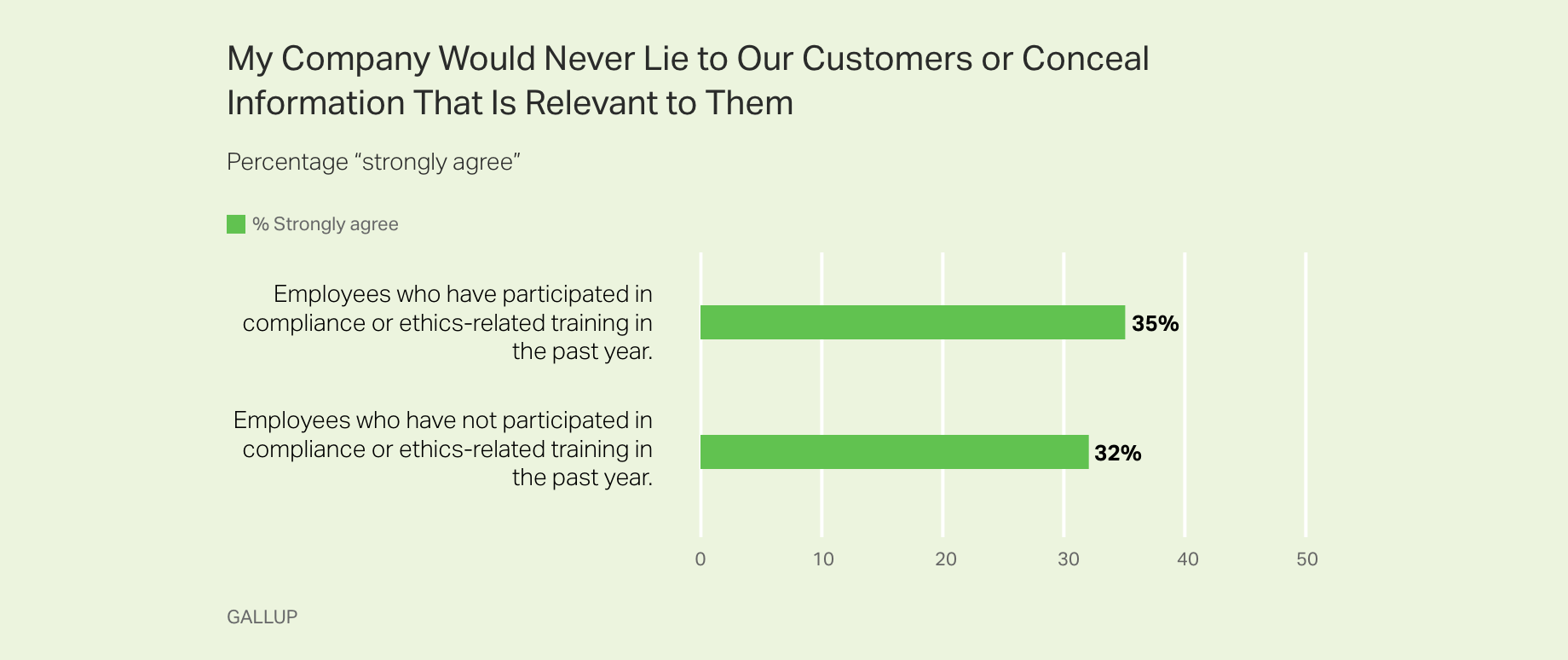
Bar graph. My company would never lie to our customers or conceal information that is relevant to them. % strongly agree.
A recent study of U.S. employees similarly suggests that participation in compliance training alone is not very impactful.

Many U.S. employees fail to benefit from ethical compliance programs.
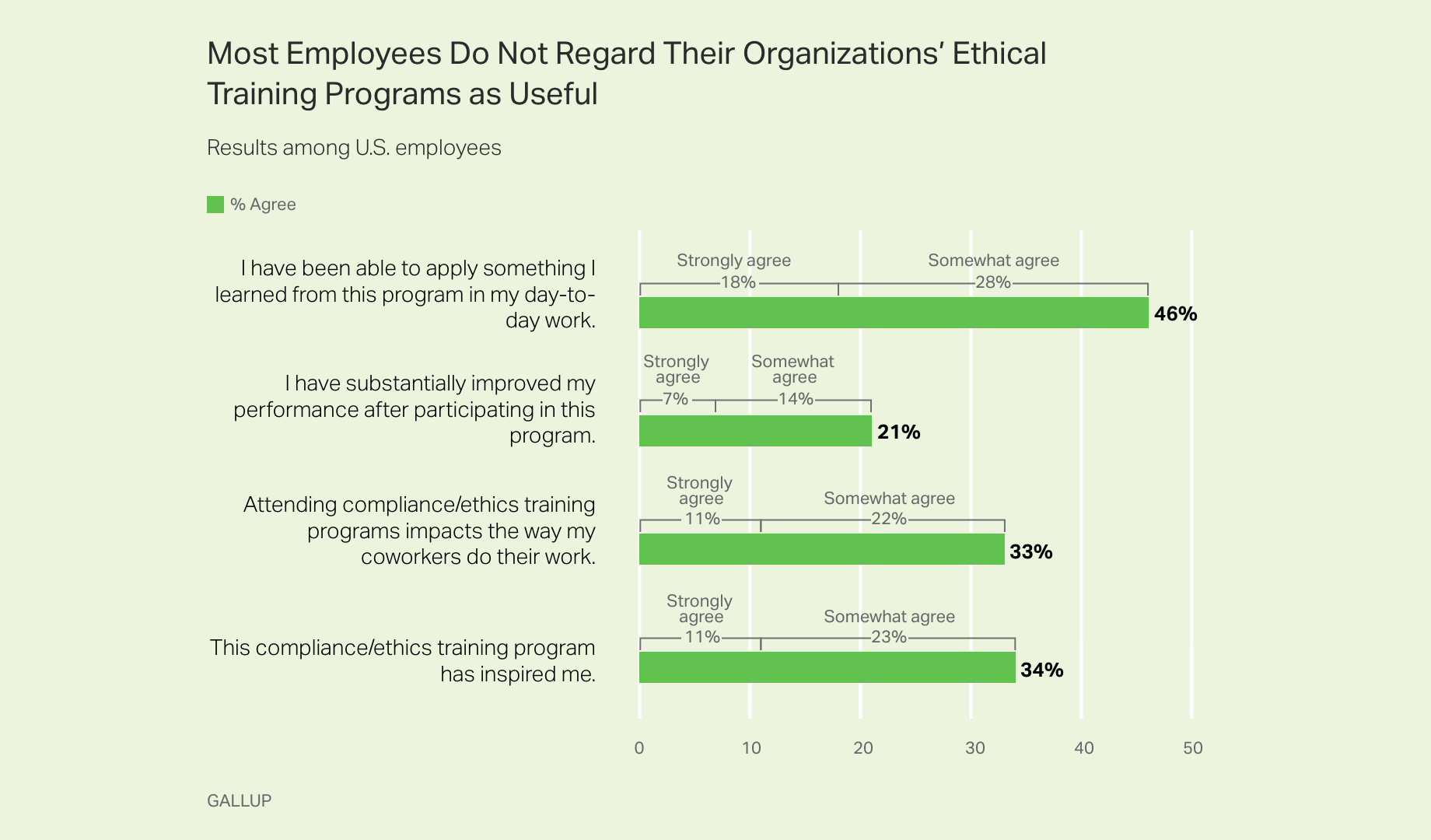
Bar graph. Most employees do not regard their organizations' ethical training programs as useful.
Gallup's recent study of U.S. employees suggests many of those who participate in ethics compliance programs do not find them particularly motivating or relevant to their jobs.
Out of more than 18,000 employees surveyed for the study, a little over half, 52%, said they had participated in an ethics training or education program sponsored by their organization. Half of those respondents said their program was web-based, while one-fourth said it was conducted in-person and the remainder received some combination of web-based and in-person training.
However, less than half of those who had participated in some form of ethics training strongly or somewhat agreed that they learned something from it that they have been able to apply in their day-to-day work (46%), while about one-fifth (21%) agreed that it has substantially improved their job performance.
One-third (33%) agreed that participation in ethics training impacts the way their coworkers do their work.
About one-third (34%) also said their ethics training had inspired them, suggesting a lack of effort on the part of many organizations to imbue such programs with meaning beyond legal or regulatory implications.
Employees who have more routine opportunities to grapple with ethical concerns, however, do tend to view their employers differently.
Across the four European countries studied, 32% of employees said their teams regularly discuss ethical issues relevant to their jobs; one-fourth (26%) say their teams do not regularly discuss ethical issues.
Among those employees who say their companies discuss ethical issues regularly, almost half (48%) strongly agree that their company would never deceive its customers.
Such findings point to the role of managers in maintaining a day-to-day focus on ethical vigilance. This is because managers are on the front lines ensuring that performance targets and incentive systems do not lead employees to (consciously or unconsciously) make unethical decisions, that employees are fully aware of ethical issues relevant to their work and that their team members feel free to express any ethical concerns.
Overall, 39% of employees in the four European countries studied strongly agree that if they raised a concern about ethics or integrity, their employer would do what is right -- but that figure rises to 61% among those who are extremely satisfied with their immediate managers.
Ultimately, strong ethical leadership is a big part of what gives employees and customers the confidence to invest in long-term relationships with organizations.
Strong ethical leadership is a big part of what gives employees and customers the confidence to invest in long-term relationships with organizations.
The one-fourth of employees in the four-country study who strongly agreed that their company will always do the right thing over an immediate profit are considerably more likely than the rest to strongly agree that they are confident in its financial future -- 56% vs. 32%, respectively.
Most understand that their organizations' choice to make integrity a cultural imperative implies a preference for sustainable success over short-term opportunism.

Additional Steps

Ghassan Khoury is Managing Partner, Europe, Middle East and Africa, at Gallup.
Steve Crabtree is a Senior Consultant at Gallup.

À Qui Pouvez-Vous Faire Confiance?: Comment la Technologie Nous a Réunis - et Pourquoi Elle Pourrait Nous Séparer


"Faites-moi confiance: c’est le livre que vous devez lire" Adam Grant, New York Times bestselling author of ORIGINALS

"Brillant décrit comment le cadre de confiance établi subit une transformation radicale à mesure que les technologies digitales numériques prennent racine dans tous les aspects de notre vie" Marc Benioff, Président Directeur Général de Salesforce

"Fascinant et bien documenté ... chaque lecteur aura de nouvelles idées" Geoff Mulgan, directeur général, Nesta

"Un livre rare qui vous fera réfléchir profondément sur votre entreprise, vos relations et votre vie" Don Tapscott, bestselling author de Wikinomics et de Blockchain Revolution

Si vous ne pouvez pas faire confiance aux responsables, à qui pouvez-vous faire confiance? Du gouvernement aux entreprises, des banques aux médias, la confiance dans les institutions est à son plus bas niveau. Mais ce n’est pas l’âge de la méfiance, loin de là.

Dans ce livre révolutionnaire, Rachel Botsman, experte en confiance reconnue dans le monde entier, révèle que nous sommes au tournant d'une des plus grandes transformations sociales de l'histoire de l'humanité - avec des conséquences fondamentales pour tous. Un nouvel ordre mondial est en train de naître: nous avons peut-être perdu confiance dans les institutions et les dirigeants, mais des millions de personnes louent leurs maisons à des inconnus, échangent des devises numériques ou se font confiance à un bot. C'est l'âge de la "confiance distribuée", un changement de paradigme impulsé par des technologies innovantes qui réécrivent les règles d'une relation trop humaine.
Si nous voulons profiter de ce changement radical, nous devons comprendre les mécanismes de la manière dont la confiance est construite, gérée, perdue et réparée à l'ère numérique. Dans le premier livre expliquant ce nouveau monde, Botsman fournit une carte détaillée de ce paysage inexploré - et explore les perspectives de l'humanité.

LA CONFIANCE EST FONDAMENTALE À CHAQUE ACTION, CHAQUE RELATION, CHAQUE TRANSACTION
 
ET CELA EST IMPORTANT MAINTENANT PLUS QUE JAMAIS AVANT ...
 
"L'efficacité est presque l'ennemi de la confiance" Rachel Botsman
 
Du gouvernement aux entreprises, des banques aux médias, la confiance dans les institutions est à son plus bas niveau. Mais ce n’est pas l’âge de la méfiance, loin de là.
 
Dans ce livre novateur, Rachel Botsman, experte en confiance reconnue dans le monde entier, révèle que nous sommes au tournant d'une des plus grandes transformations sociales de l'histoire de l'humanité. Nous avons peut-être perdu confiance dans les institutions et les dirigeants, mais des millions de personnes voyagent en voiture avec des inconnus, échangent des devises numériques ou se font confiance à un bot. Nous avons toujours confiance: mais pas comme avant.
 
Si nous voulons tirer parti de ce changement radical, nous devons comprendre comment la confiance est construite, gérée, perdue et restaurée à l'ère numérique. Dans le premier livre expliquant ce nouveau monde, Botsman fournit un guide définitif sur ce paysage inexploré - et explore les perspectives de l'humanité.


A propos de l'Auteur
 

Rachel Botsman est une experte de renommée mondiale dans une nouvelle ère explosive de confiance et de technologie, ainsi que ce que cela signifie pour la vie, pour le travail et pour notre activité. Auteur primé, conférencier et conférencier à la Saïd Business School de l'Université d'Oxford. Elle écrit et commente régulièrement pour le New York Times, le Harvard Business Review, le Wall Street Journal, The Guardian, etc. Elle est également une rédactrice en chef de Wired.

Who Can You Trust?: How Technology Brought Us Together and Why It Might Drive Us Apart


‘Trust me: this is the book you need to read’ Adam Grant,New York Times bestselling author of ORIGINALS

'Brilliantly describes how the established trust framework is undergoing a radical transformation as digital technologies take root in every facet of our lives' Marc Benioff, Chairman & CEO, Salesforce


'Fascinating and well researched...every reader will gain new insights' Geoff Mulgan, Chief Executive, Nesta

'A rare book that will cause you to think deeply about your business, your relationships and your life' Don Tapscott, bestselling author of Wikinomics and Blockchain Revolution


If you can't trust those in charge, who can you trust?From government to business, banks to media, trust in institutions is at an all-time low. But this isn't the age of distrust--far from it.

In this revolutionary book, world-renowned trust expert Rachel Botsman reveals that we are at the tipping point of one of the biggest social transformations in human history--with fundamental consequences for everyone. A new world order is emerging: we might have lost faith in institutions and leaders, but millions of people rent their homes to total strangers, exchange digital currencies, or find themselves trusting a bot. This is the age of "distributed trust," a paradigm shift driven by innovative technologies that are rewriting the rules of an all-too-human relationship.
If we are to benefit from this radical shift, we must understand the mechanics of how trust is built, managed, lost, and repaired in the digital age. In the first book to explain this new world, Botsman provides a detailed map of this uncharted landscape--and explores what's next for humanity.


TRUST IS FUNDAMENTAL TO EVERY ACTION, EVERY RELATIONSHIP, EVERY TRANSACTION

AND IT MATTERS NOW MORE THAN EVER BEFORE...

"Efficiency is almost the enemy of trust" Rachel Botsman

From government to business, banks to media, trust in institutions is at an all-time low. But this isn't the age of distrust--far from it.

In this ground-breaking book world-renowned trust expert Rachel Botsman reveals that we are at the tipping point of one of the biggest social transformations in human history. We might have lost faith in institutions and leaders, but millions of people travel in cars with total strangers, exchange digital currencies, or find themselves trusting a bot. We still trust: but not the way we used to.

If we are to benefit from this radical shift, we must understand how trust is built, managed, lost and repaired in the digital age. In the first book to explain this new world, Botsman provides a definitive guide of this uncharted landscape - and explores what's next for humanity.


About the Author

Rachel Botsman is a world-renowned expert on an explosive new era of trust and technology and what this means for life, work and how we do business. An award-winning author, speaker and lecturer at Oxford University's Saïd Business School. She writes and comments regularly for The New York Times, Harvard Business Review, The Wall Street Journal, The Guardian, and more. She's also a contributing editor at Wired.

In A Collaborative Age, Who Can We Trust?


Each year the public relations company Edelman release a 'Trust Barometer', which highlights how people feel about various institutions, companies and even professions. It's one of a number of surveys that hold a mirror up to society and delve into the trust we have in others.
What is common throughout these various surveys is that trust in institutions, whether government, corporate or religious, is plummeting. Whilst our trust in institutions plummeting, our trust in other individuals seems to be soaring. We're more likely to trust recommendations from our peers for everything from news to holidays, whilst the so called sharing economy appears to be flourishing tremendously, due in no small part to the way such platforms facilitate trusting relationships between participants.
Central to trust in any market is the so called 'market for lemons'. The theory, coined by George Akerlof is an often cited one when it comes to government regulation. It highlights how information deficiencies can lead to market failures, and therefore require regulation.

Akerlof's work highlights how used car buyers know that bad cars exist (lemons), but are ill equipped to know where they are, which lowers their willingness to pay for cars. This uncertainty in the demand side then discourages those on the supply side from offering up high quality cars. In other words, everyone loses.
A recent paper highlighted how the sharing economy overcomes this. The paper argues that the sharing economy has provided just the kind of market based solution to the lemons problem that Friedrech Hayek promoted. Indeed, the rise of the sharing economy could be seen as the natural exploitation of such a weakness in the market. It was less a failure as an opportunity.
Similarly 'distributed' forms of communicating trust exist in technologies such as blockchain, with high profile supporters, such as Don Tapscott, believing that blockchain will transform trust in society.
Who can we trust?
So is trust in crisis or on the verge of a technology driven leap forward? That's the question posed by Rachel Botsman's recent book Who Can You Trust? I met up with her recently to find out more.
Adi Gaskell: What is it about the current changes in trust that makes you think we've in the middle of something transformative?
Rachel Botsman: My fascination, and my work, really focuses on getting underneath the technology and examining human behavior, and then looking at the different strands of change and figuring out if they're connected. I started to realize that the connection is trust. If you think about it, trust has only had three chapters: local, institutional, and now distributed, and it explains so many patterns of change, and unrest.
Gaskell:  Do you think this is a very systemic change, in the sense that we have the technology now to capitalize on the lack of trust people have, or is it more of a drip drip?
Botsman: I don't think it's necessarily like I distrust this so I'm going to trust that it's not like you know your trust moves from one thing to the other. It's more that this is inherently where technology, whether it's payment systems, artificial intelligence, it's naturally where technology pulls us to take power away from the center. And so I think we often find ourselves in systems of distributed trust without realizing it. On Facebook, for instance, what you read is being determined by algorithms.
Gaskell:  From an organizational perspective, with so much apparent inherent trust given to organizations such as Facebook, even when that trust is abused. How important is trust from an organizational perspective?
Botsman: It's tempting to look at institutions and leaders and place all of the blame on them, but then there's the realization of how easily we give away our trust. You know, we probably don't think about it, but when you accept the terms and conditions, that is actually giving away our trust. When you take a recommendation you have in some way outsourced your trust to an algorithm. And so I think one of the challenges is the way products and services are designed to make everything seamless, but efficiency is almost the enemy of trust. You need a little bit friction. You have to make decisions.
Gaskell:  It's interesting with the emergence of AI, and one of things people ask for is to provide us with a sense of how the algorithms work.
Botsman: Well, we can't, it's just silly, it's too silly.
Gaskell:  So I wonder how trust will unfold in algorithms when we're either not interested or don't necessarily understand how they work?
Botsman: I think it comes down to ethics, and digital ethics is a rising field. I hate it when people say we need a digital ethicist, but we kind of do, because at the end that day it's human beings making those decisions, and you can choose to do the right thing or the wrong thing. So trusting the intentions of the people programming the algorithms is more important than understanding how they work.
Gaskell:  You mention in your book the Social Credit System in China, which is a very state run system for determining reputation, but also the distributed ledgers underpinned by blockchain on the other. What does the middle ground look like?
Botsman: I actually re-wrote that chapter several times as I realized I'd written it through a very Western lens. It's really easy to point the finger at this idea of real-time ratings and penalties that don't match the crime, but I got to thinking about how far we are off in the West in the way data is used against us.
It's why I think GDPR is so interesting because it allows you to port your data and you have the right to question and challenge algorithms that make decisions about you. That's the black box of algorithms and it's tied to how data is used and the judgements made from it.
Gaskell:  We're living in an age where 'data is the new oil', and the big tech platforms have huge amounts of our data, and it's enormously valuable to them. Is it too late to put the genie back in the bottle, or are industries such as healthcare, where our data will be digitized soon but ownership of it is still undetermined, likely to show us a new way?
Botsman: I'm more optimistic around this, because we've come out of a period of laissez faire where you (the company) take our data and you own it. I think the blockchain could be crucial as you're born with a digital identity and when my body is emitting data all the time, I will get a choice whether I sell that on to, say, an insurance company and my health insurance changes. Whatever it is, I will be in control of that decision, and I think that's why GDPR is so important, because your data belongs to you. I fundamentally believe that, and companies are increasingly agreeing with that, but they've traded on apathy and ignorance for a long time.
Gaskell:  I know the Wellcome Trust have developed a platform to help educate people around not only what data is collected about them, but their data rights (Understanding Patient Data).
Botsman: I'm not poo poohing such work, but for me it has to be built into the design of the product or service, so that people are asked "are you sure?" when their data is being requested. I think it's in the company's interests in the long-term.
To be honest though, we need a new make-up of regulators. This is a problem in that often the regulators lose sight of the end objective.  What is the end objective and then how do we design regulation around that?
Gaskell:  What will prompt that kind of regulatory framework into being?
Botsman: They will probably go in heavy handed, and does it really work in terms of changing behavior? No, so what creates reform?  That's where you'll see the nature of regulation changing, and I'm a big believer in designing this into the system.
Gaskell:  Estonia are lauded as digital champions, are they a good example of a country that is doing this well?
Botsman: I think Estonia are a great example, and a lot of that starts with integration, and they can see the flaws and faults in the system because they're all on the same backend.  Fragmentation of things gives a lot of power away. The fact that they all have a digital identity and have a degree of control over how the data is released is really powerful.
This interoperability is a key issue as citizens increasingly move around and need to take their digital identities with them.  At the moment there's so much friction around, and hopefully someone will come up with a solution to make it easier to port.


Trust is fundamental to pretty much every aspect of human life, and it's unquestionable that new technologies have had a significant impact on how trust is understood and communicated. There is a strong sense that we are at the beginnings of this journey towards a more distributed means of communicating trust, and it will be a fascinating journey to go on.

About the Author
Adi Gaskell is a free range human who believes that the future already exists, if we know where to look. From the bustling Knowledge Quarter in London, it is my mission in life to hunt down those things and bring them to a wider audience. He is an innovation consultant and writer, and the author of The 8 Step Guide To Building a Social Workplace. He has worked across private and public sectors, helping organizations discover fascinating projects and work from around the world to help trigger the innovation process. With a post graduate degree in computing, his posts will hopefully bring you complex topics in an easy to understand form that will allow you to bring fresh insights to your work, and maybe even your life.